16 bit vs 24 bit audio marks the invisible boundary where raw acoustic waves transform into immortal digital art, forever altering how we experience sound. When audiophiles sit in dimly lit rooms chasing sonic perfection, they are not merely listening to numbers; they are chasing the ghosts of vibrating air captured in micro-voltages by spinning glass and silicon.
Stepping back through history, the engineering constraints of compact discs carved out a standard that shaped decades of music consumption. Yet, human ears continually push against theoretical limits, revealing a profound gap between the clinical measurements prized by mixing engineers and the raw, emotional resonance felt by everyday listeners.
Audiophile perception meets digital reality when listeners compare the nuances of sixteen bit and twenty four bit sound files
Stepping into the realm of high fidelity sound reveals a fascinating intersection where passionate human perception collides with cold, unyielding digital mathematics. Listeners navigating the vast landscape of modern music streaming often find themselves at a crossroads, pondering whether higher numerical specifications genuinely translate to a richer emotional experience. Behind every polished track lies a complex journey of conversion, historical engineering choices, biological hearing thresholds, and sharply contrasting opinions between seasoned studio professionals and everyday listeners.
The pursuit of acoustic perfection demands a careful examination of how continuous, flowing acoustic waves are captured, preserved, and eventually reproduced through electronic transducers. As sound travels through the air, it forms a continuous wave of fluctuating air pressure that must be translated into a language computers can understand without losing the soul of the performance.
Physics of analog sound wave conversion into digital sample rates
Capturing the ephemeral beauty of a live musical performance requires translating continuous analog sound waves into a discrete series of digital numbers through a continuous process of sampling and quantization. An analog sound wave is physically represented as a smooth, unbroken curve of varying air pressure over time, which a microphone captures and converts into a fluctuating electrical voltage. To bridge the physical world with the digital domain, an analog-to-digital converter measures this voltage at extremely rapid, precise intervals known as the sample rate, typically operating at 44,100 times per second for standard compact discs or escalating much higher for professional workflows.
Alongside temporal sampling, quantization assigns a specific binary value to the amplitude of the wave at each measured snapshot, determining the available amplitude resolution. The governing principle behind this digital translation is the Nyquist-Shannon sampling theorem, which dictates that the sampling frequency must be strictly greater than twice the highest frequency component of the signal to accurately reconstruct the original waveform without aliasing distortion.
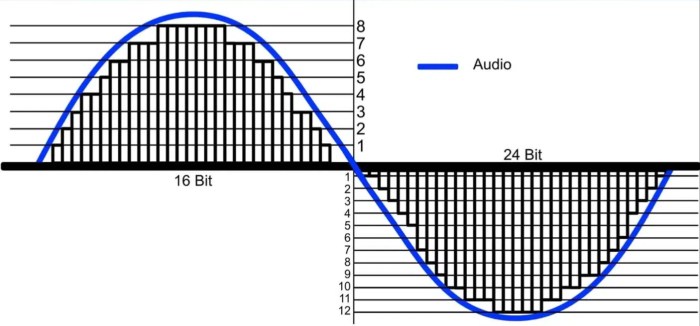
When transitioning from lower to higher bit depths, the quantization intervals become exponentially finer, drastically reducing the quantization noise floor and allowing the digital recording to mirror the subtle voltage variations of the original acoustic source with astonishing precision.
The fundamental law of digital audio states that sampling frequency dictates temporal accuracy, while bit depth dictates amplitude resolution.
Imagine a master violin recording session inside a renowned concert hall where the reverberation decays into absolute silence; the conversion process must capture not just the primary notes, but the microscopic amplitude gradients of the fading acoustic reflections bouncing off the wooden walls. To visualize this intricate engineering marvel, picture a high-resolution microscopic photograph of a vinyl record groove, overlaid with a glowing, transparent digital grid where every intersecting coordinate represents an exact mathematical snapshot of frequency and amplitude, freezing time in a pristine digital matrix.
Historical context of compact disc engineering limitations
The standardization of lower resolution audio formats was heavily shaped by the technological constraints, manufacturing realities, and consumer electronics market dynamics of the late 1970s and early 1980s. Sony and Philips spearheaded the development of the compact disc format, intentionally engineering specifications that balanced faithful sound reproduction with the physical limitations of early digital storage media and semiconductor processing power.
The choice of a 44.1 kHz sample rate and a sixteen bit word length was not chosen arbitrarily, but emerged from a strict intersection of mathematical necessity, hardware costs, and physical medium dimensions.
Engineers had to fit an entire symphony on a single, affordable plastic disc while ensuring the laser tracking mechanism could reliably read the data without overwhelming early microprocessors. This delicate balance led to several foundational technical constraints that defined a generation of recorded music:
- Physical data storage limits dictated that a maximum playback time of seventy-four minutes was necessary to accommodate Ludwig van Beethoven’s Ninth Symphony in its entirety.
- Early digital-to-analog converter chips struggled with thermal stability and linearity at higher bit depths, making sixteen bits a reliable engineering threshold for mass production.
- Bandwidth restrictions of consumer-grade electronics and CRT television interference shielding influenced the selection of the 44.1 kHz sampling frequency, ensuring adequate headroom above the twenty kilohertz human hearing limit.
These historical boundaries created a robust standard that successfully launched the digital audio revolution, proving that limited digital parameters could still deliver remarkable clarity compared to worn vinyl or magnetic cassette tapes. Recognizing these early compromises provides essential context for why modern engineers pushed beyond these historical boundaries to develop twenty-four bit and high-resolution digital audio formats.
Human hearing limitations and theoretical dynamic range thresholds
Evaluating the necessity of higher resolution audio requires examining the fascinating biological limits of the human auditory system alongside the staggering mathematical capabilities of digital formats. The human ear operates within a remarkable yet physically constrained dynamic range, spanning from the threshold of human hearing at zero decibels sound pressure level up to the threshold of pain around 120 or 130 decibels.
Within modern acoustic environments, ambient background noise—such as urban traffic, computer fans, or room ventilation—typically hovers between thirty and fifty decibels, effectively raising the practical listening floor regardless of the playback gear used.
Comparing the theoretical capabilities of digital formats against human biological limits reveals an overwhelming abundance of technical headroom:
| Audio Format | Theoretical Dynamic Range | Biological Relevance in Acoustic Environments |
|---|---|---|
| Sixteen Bit Audio | Approximately 96 dB | Matches or slightly exceeds the cleanest quiet listening rooms, though quiet details can brush against the noise floor. |
| Twenty-Four Bit Audio | Approximately 144 dB | Far exceeds human hearing capacity and physical environmental limits, providing massive headroom for uncompressed tracking. |
While sixteen bit audio offers a theoretical dynamic range of ninety-six decibels—which theoretically accommodates the entire range of human hearing in a silent room—twenty-four bit audio expands this capability to an astonishing 144 decibels. This massive leap provides forty-eight additional decibels of headroom, ensuring that subtle dynamic shifts, massive orchestral swells, and ultra-quiet studio transients are captured without the risk of digital clipping or quantization distortion.
Although human ears cannot physically perceive a 144-decibel dynamic range due to auditory masking and physiological limitations, the extra resolution serves as a vital mathematical cushion during professional mixing and mastering stages.
Contrasting subjective listening experiences of professionals versus consumers
The ongoing debate regarding the audible benefits of sixteen bit versus twenty-four bit audio often exposes a striking divide between the refined perceptions of professional mixing engineers and the pragmatic expectations of casual music consumers. Professional mixing and mastering engineers work daily within digital audio workstations where multi-track sessions accumulate hundreds of individual audio files, making twenty-four bit resolution an indispensable tool for preserving signal integrity during extensive gain staging, digital signal processing, and dynamic compression.
Because engineers manipulate audio signals repeatedly—boosting quiet passages, applying heavy equalization, and summing numerous tracks together—higher bit depths prevent cumulative rounding errors and maintain a pristine noise floor that trained ears can readily identify.
Conversely, casual music consumers listening through standard smartphones, wireless earbuds, or Bluetooth speakers rarely encounter the conditions necessary to distinguish between a master quality twenty-four bit file and a well-dithered sixteen bit compact disc recording. For the everyday listener enjoying compressed streaming formats during a daily commute, the physical limitations of playback transducers and environmental background noise mask the subtle micro-dynamics that differentiate the two formats.
This divergence highlights a central truth in modern acoustics: while professional workflows genuinely benefit from the mathematical expanse of high-resolution files, the final consumer experience depends far more on master quality production, transducer quality, and acoustic environment than on file resolution alone.
Dynamic range expansion fundamentally changes how quiet ambient sounds emerge from absolute digital silence.

Source: cleverutils.com
Stepping beyond the foundational debate of digital audio resolutions reveals a profound engineering marvel occurring quietly within every modern recording workflow. When sound waves transform into digital streams, the depth of the data container dictates an entirely new physical landscape for audio fidelity, resurrecting the faintest environmental details that previously remained buried in static hiss.
Bit depth acts as the absolute architect of a recording’s dynamic architecture, serving as the definitive ruler that measures both the highest possible peaks and the lowest retrievable whispers. Every single binary digit added to a digital audio word exponentially expands the vertical canvas available for sound pressure variations, directly altering the sonic horizon.
Bit Depth Mechanics Governing Noise Floor and Signal Headroom, 16 bit vs 24 bit audio
The core mechanism tying binary allocation to sonic purity relies on quantization, where continuous analog waves are sliced into discrete digital steps. Each bit added to the word length theoretically decreases the inherent quantization noise floor by approximately 6.02 decibels, while simultaneously pushing the ceiling of maximum signal capacity upward. This dual action grants engineers the luxury of capturing thunderous percussion alongside the delicate rustle of paper without risking digital clipping or masking the performance beneath unwanted thermal noise.
In professional tracking environments, this mathematical expansion ensures that delicate micro-dynamics—such as the natural decay of a reverberant hall—remain pristine and distinct from the baseline noise of converters.
Understanding this vertical expanse requires a close examination of the mathematical and physical limits imposed by standard digital word lengths. The following breakdown illustrates the exact boundaries governing these digital environments.
| Bit Depth | Noise Floor Limits | Theoretical Dynamic Range | Voltage Quantization Steps |
|---|---|---|---|
| 16-Bit | -96 dBFS | 98.09 dB | 65,536 steps |
| 24-Bit | -144 dBFS | 144.49 dB | 16,777,216 steps |
The mathematical relationship governing this exponential growth relies on powers of two, reflecting the binary nature of digital computing systems. Every incremental step in word length doubles the number of available amplitude values, establishing a rigid yet vast grid of measurement potential.
Dynamic Range (dB) = Bit Depth × 6.02 + 1.76
This governing formula translates every single binary addition into a compounding advantage for resolution precision. As audio engineers push beyond standard limits into higher resolutions, the exponential scaling of voltage steps guarantees that the smoothest waveforms retain their organic curves rather than devolving into jagged staircases.
Visualizing Acoustic Whispers Beneath Resolution Thresholds
Observing the behavior of extremely quiet sounds within a high-resolution audio editor reveals a vivid picture of modern digital cartography. Imagine zooming into a spectral analysis display of a live orchestral recording where a solo flutist plays a faint, breathy note in the furthest corner of a massive cathedral.
Within a standard 16-bit environment, the delicate fluctuations of that acoustic whisper hover dangerously close to the bottom quantization tier, occasionally colliding with the hard digital floor and resulting in a grainy, truncated decay. Conversely, shifting that same microscopic performance into a 24-bit visualization reveals an entirely different ecosystem of sound. The whisper floats effortlessly suspended in a vast, velvety expanse of absolute digital silence, completely detached from any underlying electrical haze.
Stepping from the crystal-clear realm of sixteen-bit versus twenty-four-bit audio depth, you might suddenly need the best excuses for calling out of work to stay home and truly listen. Once your schedule is finally cleared of distractions, return to your headphones to absorb every single acoustic nuance and dynamic wave.
The micro-transients of air passing across the embouchure hole are mapped with meticulous clarity, displaying smooth, unbroken waveforms that gently fade into infinity without a trace of digital artifacting.
Stepping beyond standard sound requires grasping how 16 bit vs 24 bit audio transforms vibrant sonic landscapes into breathing realities. Modern listeners can harness dedicated tools like usb audio player pro to unlock breathtaking acoustic depth effortlessly. Embracing this remarkable technological evolution ultimately elevates every subtle musical detail within 16 bit vs 24 bit audio.
Processing overhead during heavy mixing sessions places distinct demands on computer central processing units and storage arrays.
Source: unison.audio
While 16 bit versus 24 bit audio reveals rich sonic layers in every crisp wave, true leadership demands an equally profound depth. Discover fresh strategies on how can coaches improve team performance by harmonizing scattered talents into a unified masterpiece. Ultimately, mastering this dynamic bandwidth elevates your entire audio production to unforgettable clarity.
Stepping into the engine room of a modern digital audio workstation reveals a relentless battle between raw computational capability and massive data throughput. As creators push boundaries by scaling track counts and fidelity metrics, the underlying hardware infrastructure bears the heavy burden of keeping millions of audio samples synchronized in real time. Every single adjustment made across an expansive mixing console triggers a cascade of computational events, transforming quiet studios into high-frequency data processing hubs.
Multiplying uncompressed audio file sizes across hundreds of simultaneous tracks fundamentally alters the operational reality of a studio computer. When a production scales from standard configurations to massive cinematic or modern pop sessions featuring upwards of two hundred high-resolution tracks, the hardware resource implications multiply exponentially. Central processing units must execute countless mathematical operations simultaneously, calculating volume automation, panning coordinates, and plugin algorithms for every active channel.
The sheer volume of incoming data demands exceptional multi-core processing efficiency and high-speed memory pipelines to prevent audio dropouts, digital artifacts, and catastrophic system crashes during critical playback moments.
Solid state drive read and write speed requirements for streaming uncompressed high resolution multitrack sessions natively
The transition from mechanical spinning hard drives to high-performance solid-state storage architecture has liberated modern music production from the physical bottlenecks of the past. Streaming hundreds of uncompressed audio streams natively requires storage arrays that defy conventional data transfer limitations, relying instead on advanced NVMe technology configured through PCIe lanes. These modern drives achieve sustained read speeds that easily surpass the multi-gigabyte per second threshold, ensuring that every individual audio file feeds into the processing pipeline without a single stutter or delay.
Engineers must carefully calculate their storage bandwidth requirements based on bit depth, sample rate, and track count parameters to maintain absolute system stability during playback and recording phases.
- A single uncompressed stereo track running at 24-bit / 96kHz demands roughly 33 megabits per second of continuous read bandwidth.
- Scaling this requirement to 128 simultaneous tracks pushes the sustained data rate requirement well beyond 500 megabytes per second.
- Modern NVMe PCIe 4.0 and 5.0 solid-state drives easily accommodate these demands, offering read speeds between 5,000 and 14,000 megabytes per second.
- Hardware caching strategies and dedicated RAID arrays further safeguard against data bottlenecks during intense mixing scenarios involving heavy plugin utilization.
Buffer size management strategies that mitigate latency issues during live tracking and overdubbing procedures
Balancing the delicate ecosystem of audio latency requires a strategic approach to buffer size configuration, bridging the gap between hardware capability and real-time human perception. When artists perform live inside the studio, even a minuscule delay of ten milliseconds can disrupt their timing and emotional delivery, making aggressive buffer reduction an absolute necessity during tracking sessions. Conversely, mixing sessions demand larger buffers to accommodate the immense processing weight of complex plugin chains without overwhelming the central processing unit.
Digital audio workstations and modern audio interfaces utilize sophisticated low-latency monitoring paths and hardware-based digital signal processing to bypass native software buffers entirely during tracking. This dual-path approach allows the artist to hear their performance instantly through direct hardware routing while the computer records the high-resolution multitrack data safely in the background. Understanding this workflow transformation helps engineers maintain pristine fidelity without sacrificing the responsive tactile feedback that musicians require during high-pressure recording environments.
Visualizing the physical workspace of a high-end mixing facility reveals an impressive array of custom-built rackmount servers housing enterprise-grade solid-state storage enclosures connected directly to water-cooled multi-socket workstations. Glowing LED indicators pulse rhythmically as gigabytes of audio data stream across high-speed internal buses, while multi-monitor control surfaces display intricate waveforms moving in absolute synchronization with automated mixing consoles. In real-world scenarios, such as scoring major motion pictures at legendary facilities like Abbey Road Studios, these robust hardware configurations prove essential for handling massive spatial audio templates without missing a single transient.
Stepping into the studio, the eternal debate of 16 bit versus 24 bit audio reveals vast sonic landscapes, much like mastering the crucial boundaries of assertive vs aggressive communication in daily life. Just as finding that perfect emotional balance elevates human connection, embracing higher resolution digital audio empowers every crisp whisper and thundering bassline to resonate with brilliant, life-affirming clarity.
Memory allocation behaviors inside digital audio workstations when handling heavier file payloads
System memory acts as the primary staging ground for all active audio data, dictating how efficiently a digital audio workstation can recall, cache, and manipulate heavy file payloads. As projects incorporate hundreds of expansive 24-bit audio files alongside resource-intensive virtual instruments, random access memory usage escalates rapidly, testing the architectural limits of modern operating systems. Understanding how these platforms manage memory allocation prevents unexpected performance bottlenecks and ensures uninterrupted creative flow during critical production stages.
Workstations employ sophisticated caching algorithms to preload frequently accessed audio regions directly into fast system memory, minimizing physical drive access times during playback. However, larger file sizes reduce the total amount of audio that can reside comfortably in the RAM cache, forcing the software to swap data dynamically between storage and memory pools. Upgrading to higher RAM capacities, such as 64 gigabytes or 128 gigabytes of error-correcting code memory, provides the necessary headroom to keep entire multitrack sessions accessible at a moment’s notice.
High-resolution audio workflows demand an unyielding harmony between storage throughput, processor agility, and intelligent memory management to achieve absolute sonic transparency.
| Audio Configuration | Approximate Data Rate per Track | 100-Track Aggregate Bandwidth | Recommended Storage Technology |
|---|---|---|---|
| 16-bit / 44.1 kHz Stereo | 8.8 MB / minute | 880 MB / minute | SATA SSD or NVMe |
| 24-bit / 48.0 kHz Stereo | 14.4 MB / minute | 1.44 GB / minute | PCIe NVMe SSD |
| 24-bit / 96.0 kHz Stereo | 28.8 MB / minute | 2.88 GB / minute | High-Speed PCIe 4.0/5.0 NVMe |
| 24-bit / 192. kHz Stereo | 57.6 MB / minute | 5.76 GB / minute | Enterprise RAID NVMe Array |
Master delivery pipelines require meticulous format conversion decisions before commercial distribution on streaming platforms.: 16 Bit Vs 24 Bit Audio

Source: flstudiomusic.com
Navigating the final stages of audio production feels much like preparing a priceless historical artifact for a museum exhibition under strict environmental controls. Every single decibel of headroom and every microscopic acoustic detail captured during tracking must now survive the rigorous journey through modern global distribution networks. Producers and mixing engineers stand at a critical crossroads where artistic intent meets unforgiving technological infrastructure.
The transition from pristine studio sessions to the everyday listening devices of millions demands absolute precision and an unyielding commitment to sonic integrity.
Achieving this seamless transition requires deep respect for the underlying physics of digital audio and the mathematical transformations that govern modern media dissemination. When an immersive, high-resolution master file faces the inevitable compression and conversion protocols of global streaming ecosystems, invisible architectural choices dictate whether the music retains its original emotional resonance or suffers from subtle degradation. Understanding these mechanics transforms technical compliance into a powerful creative advantage, ensuring that the artist’s voice cuts through the digital noise with pristine clarity and unwavering impact.
The Mathematical Mechanics of Dithering During Bit Depth Reduction
Stepping down a towering twenty-four-bit master recording into the standard sixteen-bit format required for compact discs and legacy streaming tiers is an exercise in delicate digital surgery. At the heart of this reduction lies the mathematical truncation of audio data, which mercilessly lops off the lowest eight bits of every single sample. Without intervention, this abrupt amputation creates harsh, highly correlated quantization distortion—a gritty, unpleasant noise floor that clings mercilessly to quiet musical passages and decaying reverb tails.
To neutralize this mathematical violence, audio engineers deploy dithering, a sophisticated process that introduces a minuscule, carefully calculated amount of random noise into the signal before the bit depth drops. This deliberate injection of noise acts as a randomized catalyst, decorrelating the distortion from the actual music and converting ugly harmonic grit into a smooth, unobjectionable analog-style hiss that the human ear naturally perceives as benign ambient air.
Advanced noise-shaping algorithms take this concept a step further by utilizing psychoacoustic weighting filters to push the added dither noise away from the most sensitive frequencies of human hearing, typically clustering the energy above fifteen kilohertz where our auditory system is significantly less discerning. Imagine looking through a finely woven screen mesh; while the individual strands exist, your focus looks right past them to the vibrant landscape beyond.
Similarly, properly applied dither preserves the micro-dynamics and spatial depth of the original performance, ensuring that subtle acoustic cues like the gentle rustle of sheet music or the natural resonance of a concert hall remain intact even after the resolution downgrade. By trading a tiny, imperceptible rise in high-frequency noise floor for the complete elimination of digital quantization artifacts, dithering safeguards the emotional texture of the mix against the harsh realities of standard-definition playback systems.
Sequential Mastering Chain Protocols for Transient Preservation
Protecting the razor-sharp punch of acoustic drums, plucked strings, and percussive synthesizers during the arduous process of bit depth reduction requires a disciplined, highly methodical approach to signal processing. Every plugin and hardware unit in the mastering chain must be orchestrated to maintain transient velocity while preparing the audio file for the inevitable constraints of lower resolution environments. Skipping these vital preparatory steps risks dulling the impact of the production, leaving mixes sounding flat, lifeless, and fatigued by the time they reach commercial streaming servers.
- Deploy high-precision linear phase equalization early in the chain to correct surgical frequency imbalances without smearing the delicate phase relationships essential for sharp transient responses.
- Implement multi-band downward expansion gently across the lower midrange to tighten up loose frequencies, clearing vital headroom before any aggressive limiting or bit-depth truncation occurs.
- Apply parallel saturation via transformer or tape emulation models to enrich upper-harmonic density, naturally gluing the mix together while reinforcing the perceptual loudness of fast transients.
- Insert a high-end true-peak limiter as the final hardware or software stage, configured with ultra-fast attack times to catch rogue inter-sample peaks without suffocating the natural rebound of the rhythm section.
Acoustic Penalties of Defective Quantization Noise Shaping
Ignoring the fundamental laws of digital audio reconstruction during final rendering invariably invites a host of sonic anomalies that can severely damage the professional reputation of a release. When noise shaping algorithms are pushed beyond their operational limits or applied incorrectly, the resulting digital degradation transforms the listening experience from a high-fidelity journey into a fatiguing ordeal. Listeners using standard consumer headphones or laptop speakers will instantly notice these flaws, which manifest as unnatural harshness and spatial collapse.
- Granular distortion manifests as a fizzy, metallic crackle masking quiet vocal breaths and delicate acoustic instrument decays.
- Intermodulation artifacts generate harsh, dissonant frequency sidebands that cloud the stereo soundstage and exhaust the listener’s ear.
- Frequency masking obscures high-frequency air and sparkle, making cymbals sound like compressed white noise bursts rather than shimmering metal.
- Pumping and breathing effects emerge in the noise floor during quiet sections as the improperly shaped noise dynamically modulates with the music.
Enforced Loudness Normalization Parameters Across Digital Service Providers
Modern streaming platforms utilize automated loudness normalization algorithms to ensure a comfortable, consistent listening experience for users jumping between different genres and master recordings. Services such as Spotify, Apple Music, Tidal, and YouTube enforce strict target thresholds, typically centering around minus fourteen integrated LUFS (Loudness Units Full Scale) with maximum true-peak ceilings capped strictly at minus one decibel TP. When an overly compressed or improperly rendered audio file arrives at these digital distribution hubs, the platform’s automated volume reduction algorithms immediately turn the track down, inadvertently stripping away its competitive punch and leaving it sounding remarkably weaker than dynamic, carefully prepared masters.
Mastering for streaming is no longer about winning the loudness war; it is about engineering dynamic resilience that survives platform normalization algorithms with zero inter-sample clipping.
For example, if an EDM track is mastered to an aggressive minus six LUFS with zero headroom, Spotify’s normalization algorithm will drop its playback volume by eight decibels. If that same file lacks proper dither or contains heavy inter-sample clipping from rushed bit depth conversion, the resulting reduction exposes the underlying digital distortion rather than protecting the mix. Conversely, a dynamic master running at minus fourteen LUFS with pristine twenty-four-to-sixteen-bit dither applied passes through these automated pipelines untouched, retaining its full transient impact, spatial depth, and emotional warmth across every consumer device on the market.
Archival preservation practices demand extreme fidelity to protect legacy analog tape recordings for future generations.

Source: flstudiomusic.com
Time acts as an aggressive eroding force on magnetic tape recordings resting inside climate-controlled vaults across the globe. As polyester and acetate base films degrade alongside the binder layers holding microscopic iron-oxide particles in place, cultural heritage faces an irreversible vanishing point. Historical preservationists race against structural decay to rescue irreplaceable musical performances, spoken word broadcasts, and sonic documents from the mid-twentieth century onward.
By implementing rigorous digital capture methodologies, heritage institutions convert fragile analog vibrations into permanent numerical arrays that resist physical entropy.
The imperative to capture historical audio at maximum digital fidelity stems from the necessity to construct an uncompromised mathematical mirror of the original analog source. When archivists engage high-resolution conversion protocols, they eliminate quantization distortion and capture the widest possible dynamic envelope inherent in vintage media. This meticulous approach guarantees that future generations inherit every nuance of past artistic expressions without the artifacts introduced by early, less sophisticated digital formats.
Long Term Archival Rationale For Capturing Historical Performances At The Highest Possible Digital Resolution
Legacy analog tapes contain a wealth of micro-dynamics and frequency extremes that standard definition digital formats routinely truncate or distort. Recording engineers and historians advocate for twenty-four-bit depth and high sample rates because these parameters construct a mathematically vast canvas capable of accommodating the erratic signal-to-noise ratios of aged media. Historical master tapes often feature low-level ambient room sounds, subtle decays, and complex harmonic interactions that reside deep within the noise floor of the analog medium itself.
Capturing these elements at maximum resolution prevents the loss of critical acoustic data during the initial analog-to-digital conversion stage, establishing a pristine baseline for all subsequent restoration work.
The long-term economic and cultural justification for ultra-high-resolution archiving rests on the principle of single-source perfection. Repeating a delicate physical playback of a degraded master tape risks catastrophic structural failure of the magnetic ribbon. Therefore, institutions must get the digital transfer right on the very first attempt. Utilizing maximum fidelity parameters ensures that researchers, historians, and audio engineers fifty or one hundred years from now will possess a master file containing every shred of sonic information that ever lived on the physical tape.
This eliminates the need for repeated handling of fragile historical artifacts and provides an unblemished foundation for future technological advancements in audio restoration.
Strategies For Future Proofing Master Tapes Against Data Degradation And Format Obsolescence Over Decades
Protecting digitized historical recordings requires a multi-layered defensive strategy that addresses both physical media vulnerability and the rapid pace of digital format obsolescence. Archival institutions implement strict data management protocols that extend far beyond simple file storage on local hard drives. Ensuring the longevity of digitized master tapes demands a proactive methodology involving geographic redundancy, open-source file formatting, and continuous integrity verification.
To visualize the physical infrastructure of a state-of-the-art audio archive, imagine a subterranean facility maintained at precise temperatures of fifteen degrees Celsius and thirty percent relative humidity, completely shielded from electromagnetic interference. Inside this vault, robotic library systems manage thousands of linear tape-open storage cartridges, while offsite cloud servers simultaneously mirror every single byte of historical data across different continents.
This setup prevents catastrophic loss from local disasters and hardware failures.
The following practices Artikel the core technical framework utilized by modern preservation archives to combat data decay:
- Storing uncompressed master files in open-source, non-proprietary formats such as Broadcast Wave Format to prevent dependence on specific software vendors.
- Generating automated cryptographic checksums upon every file transfer to instantly detect bit-rot or data corruption over decades of storage.
- Executing scheduled migration protocols every five to seven years, moving legacy storage arrays onto current generation high-density data carriers before current hardware becomes obsolete.
Microscopic Preservation Of Subtle Harmonic Distortion And Tape Saturation Characteristics During High Bit Capture
Analog magnetic tape introduces a distinctive sonic signature characterized by warm harmonic distortion, gentle transient rounding, and pleasing tape saturation when driven near its magnetic saturation limit. These non-linear traits are not flaws; rather, they form the aesthetic soul of classic recordings created throughout the golden era of analog studios. Preserving these microscopic sonic footprints requires a digital capture chain with exceptionally high bit depth and headroom to accurately map the complex interplay between magnetic flux and electronic circuitry.
High-resolution digital capture acts as an acoustic microscope, revealing the subtle harmonic bloom of vintage magnetic tape without injecting digital quantization artifacts into the fragile upper frequencies.
When analog tape ages, the magnetic particles shift slightly, altering the saturation profile and introducing inter-modulation distortion. High bit-depth converters provide the necessary resolution to map these microscopic anomalies accurately. Without adequate dynamic range and bit depth, the subtle harmonic distortion that gives vintage soul and jazz recordings their warmth gets smeared into digital harshness, stripping away the very character that makes the historical performance valuable.
Physical And Digital Restoration Workflows Used By Audio Archivists To Salvage Degraded Magnetic Media
Restoring compromised magnetic media requires a delicate balance of mechanical intervention and surgical digital processing. Archivists never place a degraded tape directly onto a vintage tape machine without first diagnosing its physical condition. Many historical tapes suffer from sticky shed syndrome, a chemical breakdown of the polyurethane binder caused by moisture absorption over decades. This condition forces the tape to shed its magnetic oxide layer upon contact with playback heads, destroying the recording instantly if unaddressed.
The rehabilitation workflow follows a strict sequence of physical rescue operations followed by advanced spectral repair:
- Baking the compromised magnetic tape in specialized convection ovens at low temperatures for several hours to temporarily drive out absorbed moisture and restabilize the binder layer.
- Cleaning the rehabilitated tape ribbon manually using lint-free optical wipes and medical-grade solutions to remove surface dust, mold spores, and loose debris.
- Transferring the physical audio signal using a meticulously calibrated professional reel-to-reel deck featuring customized direct-drive motors and reproduction heads matched to the original recording standard.
- Applying non-destructive spectral editing software in the digital domain to surgically isolate and attenuate periodic anomalies such as tape splices, clicks, dropouts, and hums without altering the underlying musical performance.
Final Review

Source: unison.audio
Ultimately, navigating this sonic frontier is about honoring every whisper and transient punch that makes sound truly alive. Whether preserving legacy analog tapes for future generations or rendering tracks for modern streaming platforms, our pursuit of pristine fidelity ensures that the emotional heartbeat of music never fades into digital silence.