How to build a budget audiophile setup for desk workers transforms ordinary office hours into extraordinary sonic journeys, proving that remarkable acoustic fidelity belongs right at your fingertips. In the quiet hours before the morning rush, a well-tuned workstation changes from a simple collection of screens and peripherals into a personal concert hall where every note breathes with breathtaking clarity and emotional depth.
Navigating the delicate balance between professional ergonomics and uncompromising sound quality requires a thoughtful approach to nearfield listening environments. By carefully choosing micro-sized amplifiers, clever acoustic dampening, and strategically placed bookshelf loudspeakers, you unlock a hidden dimension of high-resolution audio that revitalizes your daily routine and elevates your focus to entirely new heights.
Desk bound professionals can transform their daily listening environment by understanding the fundamental acoustic limitations of office cubicles and home workstations.: How To Build A Budget Audiophile Setup For Desk Workers

Source: redd.it
Crafting an affordable desktop sound system transforms your workspace into an acoustic sanctuary where warm melodies chase away deadlines. As morning sunlight catches polished aluminum DAC knobs, pairing your pristine audio gear with Best productivity habits for busy professionals ensures your workflow remains brilliantly sharp. Ultimately, that crisp, high-resolution instrumental clarity elevates every single workday hour.
Modern desk bound professionals spend countless hours anchored to workstations, often battling an invisible acoustic war zone right at their fingertips. Transforming this everyday listening environment requires looking past standard consumer gear and confronting the raw physics of nearfield desktop audio. Every workspace tells a story of sonic compromise, where hard surfaces and ambient disturbances constantly conspire to dilute high-fidelity sound reproduction.
Daily productivity relies heavily on focus, yet office cubicles and home workstations present severe physical hurdles for clean audio propagation. Ambient office noises—ranging from low-frequency HVAC hums to the sharp clatter of mechanical keyboards—introduce masking tones that swallow delicate micro-dynamics in music. Compounding this environmental chaos is the notorious nearfield acoustic phenomenon. When speakers sit mere inches away from listeners on a polished wooden or glass desktop, direct sound waves race to the ears while premature reflections bounce aggressively off surrounding barriers.
Hard reflective surfaces act like audio mirrors, causing phase cancellation, comb filtering, and muddy midrange frequencies that rob music of its clarity and spatial depth. Sound waves collide chaotically in these confined cubic spaces, proving that high-end digital-to-analog converters and premium amplifiers cannot fix a fundamentally flawed acoustic battlefield without proper environmental management.
Acoustic Treatment Methods for Compact Vertical Partitions
Upgrading a personal listening sanctuary demands creative engineering that transcends traditional recording studio aesthetics, especially when dealing with constrained vertical boundaries. Implementing targeted, unconventional treatment strategies directly onto compact workstation dividers successfully absorbs stray energy without sacrificing precious desk real estate or violating corporate office decor policies.
Before deployment, understanding how materials interact with sound waves ensures maximum return on investment for small footprint setups. The following approaches utilize readily available household items to tame reflections and improve high-frequency articulation.
- Hanging thick, woven wool blankets or vintage tapestries over vertical fabric partitions creates a dense porous barrier that traps mid-to-high frequency reflections effectively.
- Mounting repurposed corkboard panels layered with felt fabric behind monitor arrays captures stray sound energy and prevents the slap-back echo generated between the wall and the listener.
- Assembling DIY stretched canvas art frames filled tightly with recycled cotton denim insulation yields a high-performance broadband absorber disguised as professional office decoration.
Strategic placement of these modified surfaces transforms harsh boundaries into neutral backdrops, allowing nearfield monitors to project an expansive, pinpoint accurate soundstage right across the desktop.
Acoustic Accessory Performance and Cost Metrics
Selecting the right dampening gear requires balancing financial investment against tangible sonic improvements and spatial limitations. The analytical breakdown below charts the efficacy of various compact treatment accessories frequently deployed in professional nearfield audio configurations.
| Accessory Type | Cost Range | Installation Time | Aesthetic Impact | Sound Absorption Coefficient (NRC) |
|---|---|---|---|---|
| Desktop Isolation Pads | 20 – 50 USD | 5 Minutes | Minimal and Professional | 0.65 |
| Felt Acoustic Desk Dividers | 40 – 120 USD | 15 Minutes | Modern and Sleek | 0.75 |
| Recycled Cotton Art Panels | 30 – 90 USD | 20 Minutes | Customizable Art | 0.85 |
| Molded Cork Wall Tiles | 15 – 40 USD | 10 Minutes | Warm and Textured | 0.50 |
Deploying these verified solutions bridges the gap between theoretical acoustic perfection and practical desk ergonomics, ensuring every invested dollar yields measurable improvements in listening fidelity.
Visualizing the Ideal Desktop Listening Sanctuary, How to build a budget audiophile setup for desk workers
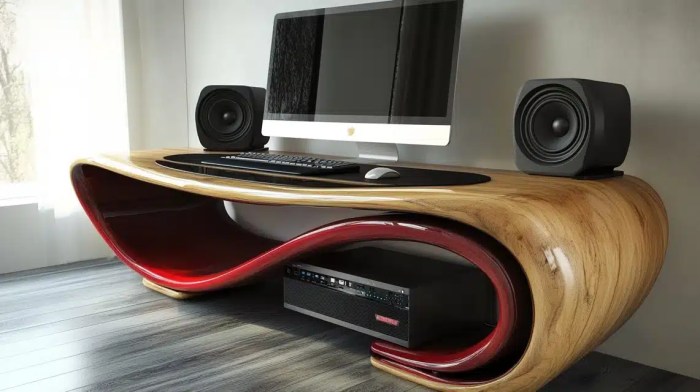
Picture an immaculate workstation bathed in the soft glow of dual ultra-wide monitors resting upon brushed aluminum arms, completely devoid of cable clutter. Flanking this visual centerpiece are matte-black active studio monitors tilted upward precisely toward ear level on heavy, resonance-damped desktop stands. Instead of glaring bare walls, the vertical boundaries are softened by rich, textured woven panels that absorb stray high frequencies while adding a sophisticated architectural warmth to the room.
Below the monitors, a sleek wool felt desk mat cushions the mechanical keyboard, simultaneously soaking up downward-firing reflections bouncing off the walnut desktop surface. Sunlight filters gently through nearby sheer curtains, illuminating a pristine space where technology and targeted acoustic engineering merge into a serene, high-fidelity listening sanctuary tailored for the dedicated desk worker.
Nearfield acoustic clarity is not achieved merely by purchasing expensive transducers, but by meticulously sculpting the chaotic micro-environment where sound waves first meet the human ear.
Selecting micro sized amplifiers and DAC combinations ensures pristine signal delivery without consuming valuable mouse pad real estate.
Modern workspaces demand uncompromising audio fidelity paired with minimalist physical efficiency. By marrying ultra-compact digital-to-analog converters with micro-sized desktop amplification, professionals can achieve master-grade sound reproduction right at their fingertips. This delicate balance of form and function revolutionizes the way office environments experience acoustic clarity.
The electrical synergy between high sensitivity nearfield monitors and desktop-class miniature headphone amplifiers represents a pinnacle of modern audio engineering. When pairing transducers that boast sensitivities exceeding 90 decibels per watt with compact amplification stages, the operational dynamic range expands dramatically. High sensitivity monitors require mere milliwatts of power to achieve comfortable listening volumes at typical desk distances of one to two meters.
This low power demand allows micro-amplifiers to operate safely within their ultra-low distortion class-A or optimized class-AB bias regions. Consequently, thermal generation remains remarkably low, eliminating the need for bulky heatsinks that plague traditional home audio receivers. Furthermore, the output impedance of these miniature amplifiers is meticulously engineered to remain well below one ohm. This low damping factor ensures absolute cone control, preventing unwanted driver resonance and ensuring that transient responses remain razor-sharp.
As electrons flow from the miniaturized circuit board through short, shielded signal paths, the signal-to-noise ratio is preserved against the hostile electromagnetic environment of a typical computer workstation. The result is an acoustic presentation characterized by pinpoint imaging, pitch-black background silence, and effortless musical engagement that defies the diminutive physical footprint of the hardware.
Comparative Analysis of Ultra Compact USB Digital to Analog Converters
Navigating the landscape of micro-sized digital-to-analog converters requires a careful examination of internal clocking mechanisms and harmonic distortion thresholds. Signal integrity depends heavily on how effectively these miniature units isolate audio data from the noisy USB bus power supplied by modern workstations.
- The Fosi Audio K5 Pro utilizes a dedicated USB receiver coupled with an advanced decoding chip, achieving an impressive total harmonic distortion plus noise rating of 0.003 percent while employing hardware-based jitter attenuation to lock onto incoming clock signals.
- The Schiit Modi+ leverages a proprietary USB input stage with isolated ground planes and dual-master clock architecture, virtually eradicating jitter artifacts and maintaining a distortion floor below 0.0006 percent for transparent digital translation.
- The SMSL PO100 PRO focuses heavily on asynchronous USB transmission, using high-precision crystal oscillators to reduce jitter down to picosecond levels while keeping distortion ratings remarkably understated at 0.0001 percent.
- The Creative Sound Blaster X1 integrates a customized multi-core processor that actively manages packet timing jitter and delivers a clean signal path with a total harmonic distortion rating resting comfortably at 0.0008 percent.
Hardware Specification Matrix for Desktop Audio Units
Evaluating physical dimensions alongside thermal and electrical performance metrics ensures seamless integration into constrained desktop environments without sacrificing amplification headroom.
| Model | Thermal Dissipation Rate | Footprint Dimensions | Maximum Power Output into 8 Ohms | Connectivity Inputs |
|---|---|---|---|---|
| Topping DX3 Pro+ | Low passive radiation via aluminum chassis | 120 x 40 x 165 mm | 1.8 Watts per channel | USB, Optical, Coaxial, Bluetooth |
| Schiit Magni Unity | Minimal ambient surface warmth | 127 x 38 x 102 mm | 2.4 Watts per channel | USB, RCA Analog |
| IFI Zen Air DAC | Negligible heat generation under load | 158 x 35 x 117 mm | 230 milliwatts per channel | USB Audio |
| FiiO K7 | Moderate warmth during sustained playback | 120 x 55 x 168 mm | 2.0 Watts per channel | USB, Optical, Coaxial, RCA |
“True desktop audio mastery is achieved not by brute force, but by the harmonious marriage of microscopic signal precision and intelligent spatial economy.”
Eliminating electromagnetic interference hum requires meticulous cable management, especially when routing unbalanced audio lines across a desk saturated with high-voltage power bricks. Stray magnetic fields from laptop chargers and monitor power supplies readily couple with unbalanced interconnects, introducing an audible 60-hertz ground loop hum into the listening environment.
- Begin by unplugging all alternating current power adapters and audio interconnects to ensure a completely safe working environment during the physical rearrangement process.
- Map out a dedicated routing corridor on the opposite side of the desk from heavy power strips, ensuring that signal cables run perpendicular rather than parallel to any high-voltage power cords.
- Utilize heavy-gauge shielded dual-core unbalanced cables equipped with braided copper shields to actively deflect stray electromagnetic radiation originating from nearby computer hardware and charging blocks.
- Elevate the audio cables using non-conductive desktop cable clips or specialized raceways to maintain a strict physical separation distance of at least six inches from all alternating current power transformers.
- Secure the final pathway with velcro fastenings to prevent the audio lines from slipping back into contact with hidden power bricks beneath the desk surface.
Modern bookshelf loudspeakers designed for close quarters listening deliver astonishing soundstages when positioned according to exact geometric principles.

Source: redd.it
The transformation of a cluttered computer workstation into an acoustic sanctuary relies on rigorous spatial geometry and meticulous speaker placement. When music creators and dedicated desk workers compress their listening environments, every millimeter of physical separation between audio transducers dictates the fidelity of the resulting soundstage. Achieving audiophile-grade imaging within arm’s reach is not a matter of pure chance, but rather the result of calculated precision that respects the physics of near-field wave propagation.
Near-field monitoring fundamentally alters how sound waves interact with human ears, bypassing most room reflections by prioritizing direct sound arrival. To unlock the full potential of miniature bookshelf monitors, listeners must abandon arbitrary placement methods in favor of strict mathematical harmonization. This deliberate approach bridges the gap between high-end studio performance and everyday workstation constraints, proving that limited square footage never has to compromise sonic purity.
Geometric Calculation of Equilateral Listening Triangles
Precision audio reproduction at a compact workstation requires strict adherence to spatial formulas that govern the relationship between the listener and the stereo monitors. In cramped environments, failing to calculate proper speaker separation leads to collapsed soundstages and severe phase cancellation. The implementation of exact geometric principles ensures that acoustic wavefronts arrive at both ears simultaneously, creating a three-dimensional holographic projection of the recorded space.
Calculating the ideal listening position begins by measuring the distance from the center of the left tweeter to the center of the right tweeter, a metric formally designated as base width ($B$). For an optimal near-field setup, this distance must match the measurement from each tweeter directly to the listener’s ear canal ($D$). This geometric relationship forms a strict equilateral triangle where $B = D_1 = D_2$.
In tightly confined computer desk scenarios, this distance typically ranges between 0.9 meters and 1.2 meters, depending on monitor cabinet width and monitor arm depth.
To execute this mathematical formula accurately at a standard computer workstation, one must apply trigonometric principles specifically tailored for constrained footprints. When desk depth limits the maximum attainable listening distance, the toe-in angle must be adjusted to maintain the apex of the triangle directly behind the listener’s head or precisely at the bridge of the nose. The governing mathematical expression for calculating the ideal desk footprint area ($A$) based on the equilateral side length ($s$) and cabinet clearance ($c$) is defined by standard geometric integration:
$A = \frac\sqrt34 s^2 + (2 \times c \times s)$
Applying this formula in real-world scenarios—such as a compact walnut writing desk measuring 120 centimeters in width—prevents boundary loading anomalies and destructive interference patterns. By maintaining this strict equilateral geometry, desk workers experience pinpoint instrument separation and lifelike vocal center imaging, effectively neutralizing the acoustic limitations imposed by nearby walls and computer monitors.
Methods for Decoupling Miniature Speaker Cabinets
Placing unisolated loudspeaker cabinets directly onto hollow wooden desk surfaces initiates sympathetic vibrations that color the midrange and muddy the lower frequencies. Effective decoupling interrupts the mechanical energy transfer between the cabinet enclosure and the furniture structure, ensuring that notes remain clean and articulate rather than lost in desk resonance.
Crafting a pristine desk audio ecosystem on a modest budget transforms daily workspace acoustics with rich, warm analog detail. Much like mastering How to pivot careers with no prior experience , upgrading your personal listening environment demands bold vision and smart resourcefulness. Ultimately, pairing affordable compact amplifiers with crisp bookshelf speakers elevates your entire daily workflow.
- High-density closed-cell neoprene foam pads absorb low-frequency vibrations before they can excite the wooden desktop, preventing the furniture from acting as an unintended passive subwoofer.
- Solid brass spiked feet concentrate the downward gravitational force of the speaker onto small contact discs, effectively draining cabinet resonance away from the critical acoustic chassis.
- Sorbothane hemispherical isolators provide visco-elastic damping that absorbs multi-axis vibrational energy, acting as a molecular sponge that transforms kinetic motion into harmless thermal energy.
- Laminated constrained-layer damping platforms utilize alternating layers of dense MDF and resilient elastomeric material to isolate desktop monitors from uneven surfaces.
- Cork and rubber composite mats offer a rigid yet acoustically inert interface that elevates the speaker while dampening high-frequency cabinet chattering.
Strategies for Angling Tweeter Heights Toward Seated Ear Canals
High-frequency sound waves are intensely directional and lose immense clarity when they pass below or above the listener’s direct line of sight. Directing tweeters precisely toward the ear canals requires specialized elevation hardware and deliberate angular adjustments to eliminate high-frequency roll-off and comb filtering.
- Custom-machined aluminum wedge stands elevate the front baffle by exactly 8 degrees, compensating for low-slung desk surfaces and aligning the acoustic axis with the seated ear level.
- Articulating desktop monitor arms equipped with VESA-compatible speaker mounting plates allow for infinite vertical adjustment and micro-rotation in both horizontal and vertical planes.
- Modular wooden trapezoidal blocks allow users to stack varying height configurations, achieving a bespoke elevation profile tailored to specific ergonomic chair heights.
- Inverted desktop stands hang compact bookshelf monitors upside down, bringing high-frequency tweeters level with seated ears while keeping heavy bass drivers safely away from boundary reflections.
- Rotatable foam wedge sets feature dual-angle bases that let users flip the incline to instantly switch between upright sitting postures and relaxed reclining positions.
Comprehensive Guide on Tuning Rear Bass Reflex Ports
Desk workers frequently position their workstations flush against office drywall, creating a catastrophic acoustic environment for rear-ported bookshelf loudspeakers. When low-frequency sound waves exit the rear port and strike a hard boundary directly behind the desk, they reflect back into the room out of phase, resulting in boomy, bloated bass response and obscured vocal details. Tuning these ports requires a calculated approach to boundary management.
Acoustic foam bungs, or port plugs, serve as the primary corrective tool for neutralizing boundary-induced low-end resonance. Inserting high-density open-cell foam plugs into the rear bass reflex ports restricts air velocity and dampens the Helmholtz resonance frequency of the cabinet. For partially closed ports, utilizing hollow cylindrical foam inserts allows a specific volume of air to escape while attenuating troublesome frequencies that trigger room modes between 80 Hz and 120 Hz.
Implementing this tuning method effectively transforms a bass-reflex speaker into an acoustic suspension design, tightening transient response at the expense of absolute low-frequency extension. For office environments where sub-bass rumble disrupts concentration and shakes computer peripherals, fully sealed ports eliminate room excitation entirely. Users should execute this tuning progressively by inserting half-density bungs first, listening to dynamic reference tracks with prominent double bass or synthesized low-end, and adjusting the density until the desk surface stops vibrating destructively while maintaining natural musical warmth.
Sourcing vintage secondhand audio components unlocks elite level sonic performance while drastically reducing initial financial investment.
Source: ahouseinthehills.com
The pursuit of high fidelity audio at a workstation rarely requires exhausting modern retail inventories when decades of masterclass engineering sit quietly within local classified listings waiting for rediscovery. Stepping back into the analog golden era reveals an underground economy of discarded sonic masterpieces that easily outperform contemporary plastic enclosures while costing a mere fraction of their original factory retail prices.
Intelligent desktop curators understand that yesterday’s flagship receivers possess structural integrity and warm musicality that modern mass-produced microchips fundamentally struggle to replicate.
Delving into the hidden advantages of acquiring Japanese receiver chassis from the late nineteen seventies for modern desktop integration uncovers a masterclass in over-engineered power supplies and robust discrete circuit topologies. Brands like Sansui, Pioneer, Marantz, and Yamaha constructed these units during an era when heavy toroidal transformers, genuine brushed aluminum faceplates, and real wood veneer cabinets were standard industry practice rather than luxury tier exceptions.
When placed upon a compact workstation, a vintage receiver delivers a generous surplus of clean, high-current analog power that effortlessly drives modern bookshelf monitors with profound depth and zero digital fatigue. Furthermore, the inclusion of exceptionally quiet, discrete phono stages within these legacy chassis allows desk-bound vinyl enthusiasts to seamlessly integrate turntable setups directly into their workspace without purchasing external preamplification devices.
The tactile resistance of weighted aluminum tuning knobs and the warm amber glow of glass-etched dial scales introduce an irreplaceable element of organic interaction that transforms a sterile digital office environment into an inspiring acoustic sanctuary.
Inspection methodology for vintage hardware acquisitions
Navigating local marketplace exchanges requires a disciplined evaluation framework to ensure that newly acquired heritage hardware functions reliably within a confined workspace setting. Physical inspection under proper lighting allows the discerning buyer to spot hairline fractures on circuit boards and asymmetrical control shafts that indicate past impact damage. Testing every input selector switch and volume potentiometer before financial exchange prevents tedious hours of future bench troubleshooting.
Executing a rigorous physical examination during local marketplace exchanges protects your investment and ensures long-term operational stability for your workspace audio hub. Careful scrutiny of the internal components and external chassis reveals whether a prospective unit has suffered from careless modifications, moisture exposure, or improper ventilation storage.
- Visual inspection of the massive main filter capacitors for bulging tops, white crystalline crust, or sticky dielectric fluid leakage which signals imminent component failure.
- Manual rotation of every rotary potentiometer and slider control while listening for static, crackling, or channel dropout indicating severe internal oxidation and carbon track wear.
- Verification of all rear-panel RCA inputs and speaker terminal binding posts for structural rigidity, corrosion, and secure chassis mounting integrity.
- Observation of the FM tuning dial string mechanism and signal strength meter responsiveness to confirm mechanical health and internal alignment accuracy.
Vintage Japanese audio receivers from the late nineteen seventies represent the absolute pinnacle of cost-effective desktop sonic enhancement, provided the power supply and signal paths undergo meticulous evaluation prior to purchase.
Evaluating the financial, operational, and acoustic realities of classic audio gear requires an objective comparative framework that weighs restoration labor against tangible listening dividends.
| Equipment Category | Average Market Value | Restoration Complexity | Acoustic ROI |
|---|---|---|---|
| Mid-Tier Japanese Receivers (1976-1979) | $150 – $350 | Moderate (Capacitor refresh & DeoxIT) | Exceptionally High |
| Vintage Solid-State Integrated Amps | $200 – $500 | Low to Moderate | High |
| Classic Analog Tuner-Preamps | $80 – $200 | Low | Moderate |
| Early Generation Compact DACs | $50 – $150 | High (Obsolete microchips) | Low |
Restoration protocols for vintage chassis maintenance
Revitalizing oxidized circuit board traces and dirty mechanical contacts demands specialized chemical cleaning agents applied with surgical precision to preserve rare faceplates and vintage silk-screened lettering. Introducing harsh industrial solvents or abrasive household cleaners will permanently erase valuable model designations and ruin the brushed metallic aesthetic of irreplaceable audio treasures. Diligent restoration work safeguards the structural integrity of historical electronics while preparing them for decades of reliable daily desktop service.
Safely cleaning delicate internal electronics requires pure anhydrous isopropyl alcohol—preferably ninety-nine percent concentration—applied via lint-free cotton swabs to dissolve decades of accumulated nicotine, dust, and flux residue without leaving conductive moisture behind. For scratchy potentiometers and stubborn input switches, specialized residue-free deoxidizing sprays such as DeoxIT D5 should be injected sparingly through manufacturer-provided access ports, followed immediately by rapid manual actuation to scrub away insulating tarnish from the internal wiper contacts.
When treating the exterior aluminum faceplate, mechanics must avoid spraying any chemical agents directly onto the chassis to prevent overspray from migrating behind glass display panels or dissolving glued-on vinyl wood-grain laminates. Instead, dampening a soft microfiber cloth with a mild solution of distilled water and neutral dish soap ensures safe removal of grime while keeping delicate vintage graphics completely intact and pristine.
Integrating powered subwoofers into minimalist workstation setups requires surgical crossover adjustments to maintain transparent musicality.

Source: redd.it
Achieving absolute sonic purity within a compact workspace demands an uncompromising approach to low-frequency management. When meticulous crossover tuning meets the physical realities of confined environments, a desktop audio system transcends its modest footprint to deliver breathtaking auditory depth.
Integrating a dedicated low-frequency driver into a space-conscious environment transforms the entire sonic landscape, provided the physical integration is executed with absolute precision. The objective is never to overwhelm the room with brute force, but rather to extend the downward response of ultra-compact satellite monitors seamlessly.
Psychoacoustic phenomena of low frequency localization
Human hearing relies heavily on interaural time differences and level disparities to pinpoint the origin of a sound source, yet these spatial mechanisms fail abruptly below eighty hertz. Because low-frequency sound waves extend well beyond several meters in length, the human ear and brain register these elongated pressures as omnidirectional, effectively masking the physical location of the driver hidden beneath the furniture.
Consequently, a properly calibrated subwoofer beneath a desk completely dissolves into the soundstage, tricking the auditory cortex into believing that all deep bass frequencies are emanating directly from the tiny desktop monitors resting beside the computer display. This auditory illusion relies entirely on steep crossover slopes that sever higher harmonic frequencies from the subwoofer, preventing directional cues like plucked string textures or vocal formants from leaking out of the floorboards and betraying the hidden position of the enclosure.
Sequential calibration methodology for desktop satellite integration
Balancing the output levels and temporal alignment between a subterranean low-frequency driver and miniature nearfield monitors requires a methodical approach using calibrated audio measurement tools. Executing this precise calibration sequence ensures absolute phase coherence and eliminates destructive acoustic cancellation zones around the listening position.
- Generate a continuous pink noise test track through the digital-to-analog converter while positioning a calibrated measurement microphone exactly at ear height in the primary listening chair.
- Adjust the variable low-pass crossover filter on the powered subwoofer until the frequency response curve displays a flat, seamless transition at the designated crossover point, typically eighty hertz for compact satellites.
- Fine-tune the gain potentiometer on the subwoofer amplifier while monitoring the real-time analyzer display until the lower register output matches the exact decibel sensitivity of the desktop monitors.
- Toggle the physical phase switch between zero and one hundred eighty degrees while observing the real-time response at the crossover frequency, locking in the setting that yields the highest amplitude peak, which confirms optimal driver synchronization.
- Perform a final playback test using complex acoustic tracks containing transient-rich double bass or synthetic kick drums to verify that the low frequencies integrate invisibly with the upper registers.
Vibration isolation methods for heavy bass enclosures
Hard laminate flooring common in modern home offices acts as a resonant amplifier, transmitting mechanical vibrations directly into the building structure and muddying the lower register clarity. Implementing robust mechanical decoupling strategies prevents cabinet energy from bleeding into the floorboards, resulting in tighter, more articulate bass delivery.
- Placement of a dense, solid concrete paver directly beneath the subwoofer cabinet adds massive inertial weight, effectively anchoring the enclosure and preventing sympathetic chassis resonances from exciting the surrounding floor surface.
- Insertion of high-durometer Sorbothane hemispherical rubber feet between the concrete slab and the laminate flooring absorbs residual vibrational kinetic energy, converting unwanted mechanical motion into harmless thermal dissipation.
- Lining the interior boundary of the desk cavity with acoustic damping foam panels absorbs early boundary reflections bouncing off surrounding walls and floor junctions, preserving transient speed and articulation.
- Position a calibrated measurement microphone vertically, pointing directly toward the ceiling at the exact physical location where your ears rest during normal desk work sessions.
- Generate a logarithmic swept-sine test signal through your playback system, ensuring the playback volume matches your typical listening loudness to account for nonlinear driver behavior.
- Capture multiple impulse responses surrounding the primary listening sweet spot using a multi-point spatial averaging method to account for minor head movements.
- Export the aggregated frequency response data into your correction software of choice to generate smoothed target curves that prioritize direct sound over erratic early reflections.
- Critical listening profiles should feature a flat anechoic target response with minimal high-frequency rolloff to expose every microscopic detail in complex multitrack recordings.
- Casual background work profiles benefit from a gentle, downward-sloping Harman-style target curve paired with a slight sub-bass boost to maintain musical engagement at lower listening volumes.
- Speech-focused conferencing profiles require a targeted midrange dip reduction coupled with high-pass filtering to enhance vocal intelligibility and minimize room reverberation interference during video calls.
- Late-night listening configurations incorporate dynamic range compression alongside an adjusted Fletcher-Munson loudness compensation curve to preserve bass fullness without disturbing neighboring rooms.
- Rigid under-desk perforated aluminum raceways bolt directly to the underside of the desktop, providing a dedicated architectural highway that cradles heavy power strips and excess power adapter brick cabling away from sensitive audio lines.
- Heavy-duty industrial Velcro channels line the interior perimeter of the desk legs, binding digital USB and Ethernet cables into flat, wide ribbons that physically separate them from vertical analog interconnect drops.
- Neodymium magnetic cable clips attach securely to steel desk frames and crossbars, suspending headphone cables and low-level interconnects mid-air to guarantee they never touch power cords or structural metal components.
- Spiral polyethylene binding wraps encase complex multi-driver desktop monitor and subwoofer cable bundles, twisting them into unified, inflexible trunks that resist accidental displacement and microphonic movement.
- Low-profile rubber floor channels bridge the gap between wall outlets and the main desk assembly, completely shielding heavy-gauge power cords from foot traffic while preventing ground loops caused by erratic cable loops.
- Purity ratings must exceed ninety-nine point nine percent oxygen-free copper to minimize signal resistance and prevent long-term terminal corrosion caused by atmospheric oxidation.
- Tight multi-strand coaxial braiding configurations cancel out external electromagnetic interference while offering exceptional physical flexibility for sharp ninety-degree bends in confined spaces.
- Outer diameter dimensions must remain under six millimeters to fit reliably inside cramped, closely spaced binding posts without causing physical strain or short circuits.
- Gold-plated locking banana plugs or heavy-duty pin connectors must be professionally soldered to the wire ends to prevent frayed copper strands from touching adjacent terminals.
- Dielectric insulation materials consisting of high-density polyethylene or fluorinated ethylene propylene reduce capacitance and dielectric absorption, preserving high-frequency transient response accuracy.
Visual harmony and cable management aesthetics
A truly minimalist workstation conceals its acoustic machinery behind clean architectural lines and purposeful spatial arrangement. The powered subwoofer rests quietly in the deepest recess of the leg well, wrapped in a matte black finish that absorbs ambient light and visually recedes into the shadows beneath the desktop surface. Braided power cords and shielded low-level signal cables run parallel to the steel desk legs, held securely by magnetic raceways that eliminate any visual clutter from the primary field of view.
The compact satellite monitors flank the ultra-wide display on heavy metal desktop stands, creating a balanced geometric triangle that emphasizes minimalist elegance without sacrificing sonic authority. When viewed from the doorway, the entire workstation presents a harmonious blend of high-performance engineering and restrained interior design, where every technological element serves a distinct acoustic and visual purpose.
“True high-fidelity desk audio is not about overwhelming acoustic volume, but about the seamless illusion of massive sound emerging from invisible physical sources.”
Customizing digital signal processing profiles corrects phase cancellation anomalies inherent in asymmetrical computer workspace layouts.
Modern desk environments present unique acoustical challenges that traditional room treatment often fails to resolve completely. The close proximity of hard reflective surfaces, combined with off-center seating positions, creates severe phase anomalies and frequency response aberrations. By implementing targeted digital signal processing interventions, listeners can systematically dismantle these physical acoustic limitations and achieve a remarkably balanced sonic presentation directly at the listening position.
Parametric equalization software acts as the primary architectural tool for reshaping the acoustic signature of a desktop audio system. When flanking dual monitor displays dominate the workspace, they create a physical barrier that drastically alters high-frequency dispersion and low-frequency energy distribution.
Boundary loading reinforcement compensation through parametric equalization
Dual monitor arrays positioned symmetrically or asymmetrically across a desk create a massive acoustic baffle right in front of the listener. This physical obstruction leads to a phenomenon known as boundary loading reinforcement, where low-mid frequencies between 150 Hz and 300 Hz experience severe acoustic buildup because sound waves reflect off the rear of the panels and the desk surface simultaneously.
Parametric equalization software addresses this issue by deploying precise infinite impulse response or finite impulse response filters that apply targeted negative gain notches to counteract the exact frequencies undergoing constructive interference.
Crafting an affordable desk audio system elevates daily work, much like How to find a mentor in your current industry accelerates professional growth. By pairing budget compact DACs with warm vintage speakers, you curate an inspiring workspace soundtrack. This intentional sonic upgrade transforms sterile office hours into an immersive, harmonious symphony of daily productivity and focus.
When configuring software-based correction suites, users must analyze the specific dimensions of their monitor array. For instance, a dual 27-inch monitor setup typically introduces a comb filtering effect that severely impacts the upper midrange response around 1 kHz to 3 kHz. By deploying narrow Q-factor parametric filters, the digital processor attenuates these specific reflection peaks without starving the direct sound path of vital musical information.
This surgical intervention restores natural timbre and linear frequency progression, ensuring that instruments retain their proper weight and spatial localization despite the physical clutter of the desktop landscape.
Beyond static frequency attenuation, advanced equalization engines utilize dynamic filtering to manage transient energy spikes caused by monitor housing reflections. As acoustic energy bounces off the bezels of side-by-side screens, it arrives at the microphone at micro-delayed intervals, smearing transients and clouding the soundstage. Applying linear-phase parametric adjustments ensures that phase relationships remain intact across the entire audible spectrum, preventing the digital correction process from introducing audible smearing or phase distortion while taming the unruly boundary reflections.
Selecting the optimal freeware room correction suite requires careful balancing of processing overhead, user interface complexity, filter capabilities, and measurement accuracy. The following comparative matrix Artikels the operational parameters of leading digital signal processing solutions available for desktop audiophile integration.
| Software Suite | Processing Latency | Interface Complexity | Filter Type Limits | Measurement Precision |
|---|---|---|---|---|
| Equalizer APO | Ultra-low (approx. 5-10ms) | High (Text-based config or GUI plugins) | Unlimited parametric, graphic, and convolutional | High when paired with external measurement data |
| Reaper ReaFIR | Variable (depends on FFT size) | Moderate (DAW plugin environment) | FFT-based brickwall and dynamic EQ | Moderate for real-time room analysis |
| Host-based Convolver Plugins | Medium to High (20ms+) | Low to Moderate | Impulse response convolution limits only | Extremely high based on loaded WAV profiles |
| OpenDRC Control Software | Hardware-bound (fixed buffer) | Low (Dedicated hardware routing) | Bi-quad parametric and crossover blocks | Dependent on external capture software |
Executing precise acoustic measurements forms the foundational baseline upon which all subsequent digital signal processing corrections rely. Without accurate data capture at ear level, parametric filters will attempt to correct phantom anomalies, ultimately degrading the overall listening experience.
Crafting a pristine desk audio ecosystem transforms tedious workdays into sonic journeys, proving that acoustic clarity requires smart curation rather than immense wealth. Just as exceptional minds sharpen their vision through Best books on leadership and personal development , assembling budget DACs and bookshelf speakers elevates your workspace atmosphere, delivering rich, resonant soundscapes that inspire daily focus and professional momentum.
Different operational scenarios demand distinct acoustic profiles to maximize both analytical clarity and long-term listening comfort. Maintaining a library of hardware and software preset configurations allows users to seamlessly transition between intense analytical tasks and relaxed ambient listening.
“True desktop fidelity is not merely purchased through hardware acquisition, but meticulously sculpted through the harmonious alignment of physical placement and digital phase correction.”
Implementing meticulous cable management hierarchies preserves signal purity and elevates the visual elegance of an audiophile workstation.
Behind the polished aluminum faceplates and glowing vacuum tubes of a high-end desktop audio system lies a complex web of electricity and data. When energy flows through unshielded conductors in close proximity to high-frequency digital pathways, invisible physical forces threaten the integrity of the listening experience. Transforming a chaotic cluster of copper and plastic into an architectural masterpiece requires deliberate physical organization, specialized routing hardware, and a rigorous approach to wire selection.
Running unshielded analog interconnects parallel to high-speed Ethernet cables and heavy alternating current power lines introduces severe electromagnetic consequences that degrade sonic fidelity. As alternating current pulses through power cords at fifty or sixty hertz, it generates an expanding and collapsing electromagnetic field. When unshielded analog signal lines—which carry delicate millivolt-level audio signals—run parallel to these magnetic fields, inductive coupling occurs.
This physical phenomenon injects unwanted hum directly into the amplification chain, permanently compromising the noise floor of the system. Furthermore, high-speed Ethernet cables transmit high-frequency digital data packets that produce radio frequency interference. Without proper physical separation or metallic shielding, this high-frequency noise bleeds into sensitive digital-to-analog converter outputs, resulting in a harsh, glary treble response and a constricted soundstage.
Audiophile engineering principles dictate that analog signal paths must intersect digital or power conduits strictly at ninety-degree angles to minimize mutual inductance. Maintaining a physical distance of at least six inches between unshielded audio cables and heavy power delivery systems prevents the electromagnetic radiation from imprinting upon the musical waveform, ensuring that the dynamic range of the recording remains utterly pristine from source to transducer.
Electromagnetic Interference Mitigation and Spatial Routing Tactics
Achieving absolute silence in a high-fidelity desktop environment demands innovative physical routing strategies that isolate vulnerable signal pathways from noise-emitting infrastructure. By deploying advanced containment hardware, desktop engineers can completely eliminate both acoustic degradation and visual clutter.
The following deployment strategies permanently secure and isolate all desktop infrastructure:
Visualizing this workspace reveals a striking sensory experience where high-end audio machinery appears suspended by pure engineering magic rather than tethered by physical tethers. The visual narrative unfolds across a solid walnut desktop resting on minimalist matte-black steel trapezoidal legs. Dual monoblock amplifiers and a reference-grade digital-to-analog converter sit upon isolation platforms, their brushed metallic surfaces catching the warm ambient glow of a desk lamp.
Yet, scanning the rear panels and the space beneath the furniture reveals an absolute absence of tangled wires. Every power cord, USB data link, and analog interconnect dives cleanly downward through precisely bored grommet holes fitted with brushed nickel bezels. Beneath the surface, the under-desk raceways hold every millimeter of excess length in disciplined, mathematically straight lines. The speaker wire emerges from hidden wall ports, gliding directly into the rear binding posts of the bookshelf monitors with zero slack, giving the impression that the music is materializing out of thin air.
Oxygen Free Copper Wire Selection Criteria
Selecting the ideal wire to bridge the amplifier and the desktop loudspeakers requires careful attention to metallurgy, physical dimensions, and terminal geometry. Cramped spaces behind nearfield monitors demand specific physical attributes to ensure a secure and oxidation-free connection.
The following criteria govern the selection of braided oxygen-free copper speaker wire for confined desktop installations:
Meticulous physical separation of power and signal paths is not merely an aesthetic preference; it is the fundamental barrier that stands between transparent sonic reproduction and contaminated background noise.
Real-world implementations of these physical hierarchies demonstrate measurable improvements in signal-to-noise ratios across desktop listening stations. For instance, high-end workstations utilized by audio mastering engineers in compact studio environments routinely employ braided oxygen-free copper cables routed through magnetic isolation clips to eliminate baseline hum entirely. When these physical protocols are rigorously followed, the listener experiences an unobstructed window into the recorded performance, free from the electronic artifacts of the modern digital workspace.
Closing Summary

Source: redd.it
Crafting your ultimate personal listening sanctuary is an empowering journey that merges technical precision with deep artistic appreciation for sound. As every cable falls neatly into place and the first notes ripple across your workspace, you realize that true fidelity is not merely about expensive hardware, but about intentional design bringing extraordinary beauty directly into your everyday life.
